

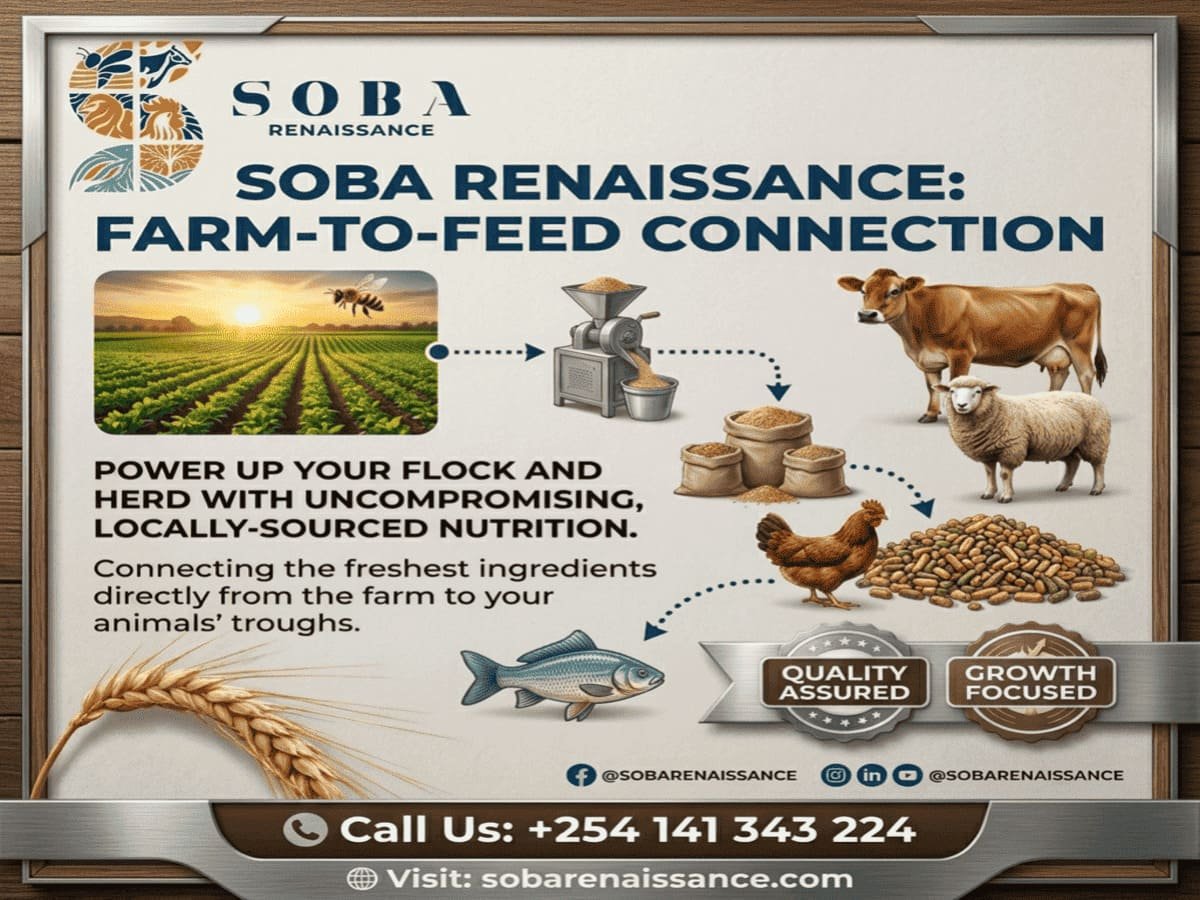
The Farm-to-Feed Connection: How Agricultural Ingredients Become Livestock Nutrition
When people think about agriculture, they often picture fields of growing crops or livestock grazing on a farm. Yet an important connection between these activities is easily overlooked: crops and other agricultural materials can become ingredients in the diets that nourish farm animals. Understanding this connection is essential to understanding how food systems operate.
At Soba Renaissance, producing our own animal feed forms part of our agricultural work. It creates an opportunity to engage more directly with the ingredients, formulations, and management decisions involved in feeding livestock. The farm-to-feed connection is about much more than moving grain from one location to another; it is about turning appropriate agricultural materials into safe, nutritionally useful diets.
1. What Does “Farm to Feed” Actually Mean?
Farm to feed describes the process through which suitable agricultural ingredients are sourced, assessed, processed, formulated, stored, and delivered as livestock feed. Some ingredients may come directly from crop production, while others are produced through agricultural processing.
The journey can involve harvesting grains, drying and storing them, milling or otherwise processing ingredients, mixing a formulated ration, and distributing finished feed to animals. Each stage can affect nutritional value, safety, cost, and resource use. A good system considers all of these factors together rather than treating feed as a single finished commodity.
2. Understanding the Ingredients That Make Up Feed
Feed ingredients have different roles. Cereals such as maize can contribute energy; appropriate protein sources, including certain oilseed meals, provide amino acids needed for growth and maintenance. Minerals and vitamins are included where necessary to help meet species-specific requirements. For ruminants, suitable roughages and forage are also essential components of the feeding system.
The exact combination depends on the animal. Poultry, goats, cattle, and other livestock differ in digestive systems and nutrient requirements. Even within one species, the diet may need to change as animals grow, reproduce, or lactate. No single ingredient, however valuable, provides everything an animal needs.
3. Why Formulation Matters More Than Simply Mixing Ingredients
Feed formulation is the process of selecting ingredient quantities to achieve an appropriate nutritional profile. It takes account of factors such as energy, protein, amino acids, minerals, fibre, ingredient availability, and feed safety.
A mixture can contain high-quality ingredients and still be nutritionally unbalanced. Too little of an essential nutrient may limit performance or compromise health; excessive amounts of some nutrients can also cause harm or waste. Responsible feed formulation should be guided by established nutrition standards and, when appropriate, qualified animal nutrition professionals.
For farmers, accurate weighing, mixing consistency, and clear batch records help make formulations reproducible and easier to review.
4. The Importance of Ingredient Quality and Safe Handling
Agricultural ingredients are subject to natural variation. Harvesting conditions, moisture content, processing, and storage can all affect their condition. Feed exposed to excess moisture may develop mould, and some moulds can produce harmful mycotoxins. Pests and poor sanitation can also introduce contamination.
Quality management therefore begins before mixing. Farmers should assess ingredient condition, use suitable storage facilities, maintain hygiene, and follow appropriate testing procedures where necessary. Ingredients that are visibly spoiled or suspected to be contaminated should not simply be fed to animals. Internal feed production offers greater visibility, but it does not replace the need for controls.
5. How Feed Production Connects Crop and Livestock Farming
Crop and livestock systems can complement one another. Suitable crop materials may become animal feed, while properly managed livestock manure may contribute organic matter and nutrients to soil. These relationships can support more integrated use of agricultural resources.
However, circularity requires careful management. Not every crop residue or processing by-product is safe or digestible for livestock. Manure handling also needs attention to hygiene, nutrient balance, and environmental protection. A responsible approach evaluates the suitability of each material instead of assuming that all agricultural by-products should be reused.
6. Feed Production, Animal Welfare, and Daily Management
Feed quality is closely connected to animal welfare, but the manner in which feed is supplied matters too. Animals need access to sufficient feed and clean water, with feeding arrangements suited to their species and behaviour. Overcrowded troughs, irregular feeding, or inappropriate rations can create stress and nutritional problems.
Monitoring body condition, growth, appetite, and feed consumption helps farmers identify when adjustments may be needed. Nutrition is one part of a wider animal-care program that also includes shelter, hygiene, veterinary attention, and appropriate handling.
7. What Farm-Produced Feed Can and Cannot Guarantee
Producing feed on the farm can improve visibility into ingredient selection, mixing procedures, and inventory management. It may help a business coordinate feed planning with the needs of its livestock. These are potential operational advantages, not automatic proof of superior feed.
Nutritional adequacy still depends on correct formulation, ingredient quality, testing where appropriate, and safe storage. Similarly, producing animal feed internally does not by itself establish that meat is organic or that a farm meets any particular certification standard. Such claims require evidence and must reflect applicable standards.
8. Why This Connection Matters to Consumers
Consumers are increasingly interested in how food is produced. Knowing that feed is part of the agricultural value chain helps people ask informed questions: What do animals eat? How are ingredients sourced? What checks protect feed safety? How does the farm respond when nutritional requirements change?
Answers to these questions can support transparency and build understanding. Nevertheless, the safety of meat, milk, and eggs depends on more than feed. Animal health, hygienic processing, refrigeration, transport, and household food handling are also essential.
9. Practical Ways Farms Can Strengthen the Farm-to-Feed Process
Good practice starts with clear ingredient specifications and dependable records. Farms can document incoming materials, inspect storage conditions, label feed batches, review formulations, and monitor animal responses. Appropriate staff training helps ensure that feed is handled consistently.
Inventory rotation can reduce unnecessary spoilage, while suitable feeders may limit spillage. When introducing new ingredients or changing formulations, farms should evaluate nutritional suitability and safety rather than making abrupt assumptions. Continuous improvement comes from observing results, recording them, and making informed adjustments.
10. The Soba Renaissance Perspective
At Soba Renaissance, our involvement in animal feed production reflects our interest in the foundations of responsible agriculture. We believe that the journey from agricultural ingredient to livestock ration deserves the same attention as the food products consumers eventually purchase.
By sharing educational information about feed, livestock care, soil, and food production, we aim to encourage more informed conversations between farms and consumers. Our focus is on explaining the connections that make agriculture work and the decisions that can help improve it.
A More Connected View of Food Production
The farm-to-feed journey brings together crops, ingredient handling, animal nutrition, and everyday livestock management. It reminds us that food production involves many stages before products reach the market.
Understanding those stages supports better questions, better management decisions, and greater appreciation for responsible farming. At Soba Renaissance, we see animal feed production as an important part of that wider agricultural story.